TUESDAY’S EXPLOSION AT DELFIN LNG IS THE LATEST IN A LONG SERIES OF LNG INCIDENTS AND VIOLATIONS
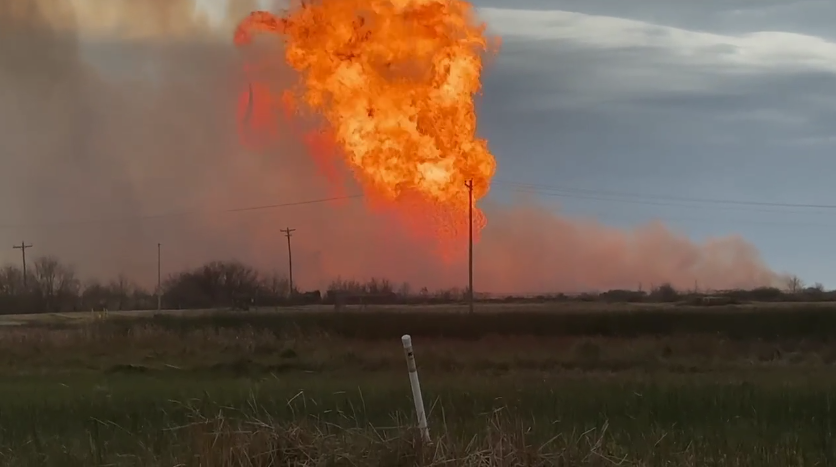
(credit: Roishetta Ozane/The Vessel Project)
Additional video content available from KPLC
Cameron Parish, Louisiana – A gas pipeline exploded in Cameron Parish, Louisiana, on Tuesday, February 3rd, 2026, and continued to burn for several hours.
Local news station KPLC reports that the fire occurred at the Delfin LNG pipeline, near the towns of Holly Beach and Johnson Bayou. A pipeline operator was injured, and students at Johnson Bayou High School, located six miles from the pipeline, were ordered to shelter in place.
This pipeline rupture is the latest example of the safety concerns posed by liquified natural gas, a highly flammable material. The US LNG industry has been marked by years of incidents and environmental violations.
Local community organization The Vessel Project immediately responded to monitor the incident. Quotes from impacted community members with The Vessel Project are listed below.
This is a developing story.
MEDIA CONTACTS:
- Roishetta Ozane – Founder, Director & CEO with The Vessel Project
roishetta@gmail.com, (337) 564-1254 - Michael Esealuka – U.S. Petrochemical Coordinator with Break Free From Plastic
michael@breakfreefromplastic.org, (504) 444-6723
QUOTES
- “Today’s pipeline explosion in Cameron Parish is deeply concerning and heartbreaking. My thoughts are with the residents, families, and first responders who were impacted. Incidents like this are a painful reminder of the risks our communities face when safety, transparency, and accountability are not prioritized. Cameron Parish and Southwest Louisiana deserve stronger protections, clearer communication, and proactive measures to prevent tragedies like this from happening. Our communities should never have to trade safety for industry profit. I stand with those affected and call for answers, accountability, and meaningful action moving forward.” — Keondra Martin, Outreach Coordinator at the Vessel Project & SWLA resident
- “As a now senior at Sulphur High School, I have experienced multiple shelter in place. Sometimes the conditions were so bad that they caused me to stay at school hours after dismissal due to the shelter in place not being lifted. When I heard about the pipeline explosion in Cameron Parish today my first thought was how this would affect the kids and what are we as a community going to do to fix this reoccurring issue?” — Kami Ozane, local student
- “Incidents like this show why stronger oversight and safety measures are necessary, especially when pipelines are located near homes and schools. No community should have to fear explosions from pipelines near their homes or schools. Safety should always come first.” — Ala’Jha Frank, Field Organizer for the Vessel Project & SWLA resident
- “Federal agencies continue to approve and expand LNG export and natural gas projects without proper oversight, limited federal guidance, and shortages of operational staff. When industries and regulatory agencies consistently prioritize profits over basic safety standards, it leads to increased industrial disasters, such as the pipeline explosion at Delfin LNG and the previous explosion at Freeport LNG in Texas.
- Communities across the country continue to push back against hazardous regulatory decision-making, leaving thousands of comments and even taking battles to court. as a Nation, it is critical that we pay attention and stand in solidarity with those who are living and standing up at the fenceline, because they are the ones leading the fight to protect the entire planet.” – Kari Fulton, Climate and Environmental Justice Policy Organizer, Educator, Founder/ Editor-in-Chief, Checktheweather.net
- “These facilities have not been running in a safe manner all along, but with the Trump Administration weakening safety and chemical regulations even further, what happened in Cameron will become the norm. We’ve seen disasters throughout this country, but LNG is like a bomb waiting to explode. Delfin is huge in comparison to Freeport LNG, and there are workers and community members who are vulnerable. We can’t trust companies to provide accurate data on injuries or chemical releases. You might not get the real story unless you know someone who lives nearby. It violates the constitution as fas as people’s safety, health, and environment. This is not a Cameron issue, this is a U.S. and global issue. “ – Gwendolyn Jones, Founder, Director, Climate Conversations of Brazoria County, Texas
ADDITIONAL BACKGROUND:
Liquified Natural Gas (LNG) + LNG Pipelines:
- This pipeline carries liquified natural gas (LNG), also known as methane gas.
- To transport methane gas, it must be cooled to subzero temperatures and highly pressurized into a semi-liquified state.
- To maintain high pressures, LNG is periodically compressed throughout its route. This is achieved through above-ground infrastructure called Compressor Stations, typically located every 40 to 100 miles along a methane gas pipeline route. Compressor stations frequently leak methane and other pollutants, such as particulate matter (PM), nitrogen oxides (NOx) and volatile organic compounds (VOCs).
- Methane gas is volatile and highly flammable. If exposed to an ignition source, methane gas vapor clouds can trigger fires and explosions that cannot be extinguished using water.
LNG Buildout in Louisiana:
- Southwest Louisiana is the site of one of the largest expansions in LNG export infrastructure in the US. Each LNG terminal requires miles of highly pressurized pipeline networks to supply the product.
- Cameron Parish is home to three LNG export facilities – Cheniere’s Sabine Pass LNG, Venture Global’s Calcasieu Pass LNG, and Hackberry’s Cameron LNG – with more proposed.
- Louisiana leads the nation with four LNG export terminals in operation as of 2026, along with hundreds of miles of LNG pipelines. Texas has two operating LNG export terminals with several more in development.
- This incident reportedly occurred at a Delfin LNG pipeline. Delfin LNG has sought to build an export terminal in Cameron Parish since 2015 but has faced countless delays, which the company has blamed on COVID, US-China trade wars, changing technology and “new management.”
- Delfin LNG has received the necessary permits to construct an offshore LNG terminal, though it has requested an extension to 2027 to begin export operations.
Environmental Integrity Project Map —

Long Track Record of Safety Violations + Unlawful Pollution:
- According to an October 2025 report from Environmental Integrity Project:
- Over the past five years, all seven US LNG export terminals in operation as of 2024 have violated their air pollution control permits.
- Over the past five years, five of the seven total US LNG export terminals in operation as of 2024 have violated water pollution control permits.
- In the past three years, all seven US LNG terminals in operation as of 2024 were non-compliant with the Clean Water Act or Clean Air Act for at least one quarter.
- All three of Cameron Parish’s LNG export terminals routinely violate federal and state pollution laws.
- Sabine LNG and Calcasieu Pass LNG have been out of compliance with Clean Air Act rules for the past three years.
- Cameron LNG has been out of compliance for 11 of 12 quarters over the past three years.
- The five LNG export terminals in Texas and Louisiana operating as of 2024 have reported at least 425 malfunctions, incidents and ‘upsets’ that released over 14,155 tons of air pollution – more than 28 million lbs.
- In 2018, Cheniere Energy was fined and ordered to shut down two tanks at Sabine Pass LNG after failing to deal with known leaks.
- In 2022, Calcasieu Pass was cited by the Louisiana Dept. of Environmental Quality for 139 instances of violating permitted release levels.
- An LNG export terminal in Freeport, TX exploded in 2022 after methane gas was exposed to an ignition source. That explosion shut down the facility for eight months and led to $275 million in damage. Freeport LNG had a history of safety violations well before the 2022 explosion.
Lack of Regulation Leaves Residents in the Dark:
- The LNG industry is regulated by three federal agencies (Pipeline & Hazardous Materials Safety Agency/PHMSA, Federal Environmental Regulatory Commission/FERC and the US Coast Guard), leaving rules around safety protocols and information disclosure opaque.
- For its role in regulating LNG, PHMSA has long relied on outdated regulations aimed at the use of LNG at gas powerplants, not export infrastructure– regulations that date back to the 1980s.
- In 2025 PHMSA initiated a new rulemaking process to update its LNG regulations, but rules to protect communities are unlikely to be strengthened; the agency specifically requested input on how to ‘best design a rulemaking … for LNG facilities to be deregulatory and lead to cost savings for the industry.”
- Key safety information about LNG facilities is often kept confidential because the facilities are considered ‘critical infrastructure.’ Companies can also use trade secret provisions to shield information from the public.

###