Community, health, and environmental groups recently filed a lawsuit against the Trump Administration to halt what they call an unlawful carve-out that allows over 50 chemical manufacturing plants to continue emitting cancer-causing pollutants.

Fenceline Communities in Louisiana and Texas are Fighting to Breathe
These legal challenges stem from a presidential proclamation that delays compliance deadlines by two years for approximately 50 of the nation’s most polluting chemical plants. The Hazardous Organic National Emission Standards for Hazardous Air Pollutants also known as the HON rule, would reduce toxic chemical emissions from equipment and processes used in the manufacture of synthetic chemicals and polymers. The rule also increases monitoring and remediation of emissions for communities living within the fenceline region of a chemical industrial facility.

A report by the Environmental Justice Health Alliance for Chemical Policy Reform (EJHA) notes that 39% of the U.S. population (approximately 124 million people) live within a three-mile radius of a chemical facility.
Environmental law firms Earthjustice, NRDC, Environmental Integrity Project, and Environmental Defense Fund are representing the diverse coalition of plaintiffs from impacted communities in Louisiana and Texas. They argue that if the HON rule is successfully implemented, it would reduce emissions by 6,200 tons per year and decrease cancer risk near these facilities by approximately 96 percent. “These unlawful presidential exemptions are one of the clearest examples of who matters to the Trump administration and who doesn’t,” said Adam Kron, senior attorney with Earthjustice.
What is the HON Rule Anyway?
The HON rule, finalized in May 2024, imposes stricter regulations on certain chemical manufacturing facilities. The policy changes were viewed as a long-fought victory for communities living near industrial facilities. “Community leaders in this movement have fought for protections like this for more than 30 years,” said Ana Parras, Co-director of Texas Environmental Justice Advisory Services (TEJAS).

Shifts in Federal Regulation
In July 2025, President Donald Trump issued a proclamation that exempted major industrial facilities owned by companies such as Shell, Dow Chemicals, CITGO, and more from pending changes mandated by the HON Rule. The White House statement argued that the new regulations would cause a “significant burden” on existing chemical facilities. Trump claimed that the technology needed to meet these advancements is not readily available, stating,
“The HON Rule imposes requirements that assume uniform technological availability across facilities, despite significant variation in site conditions, permitting realities, and equipment configurations. A disruption of this capacity would weaken key supply chains, increase dependence on foreign producers, and impair our ability to respond effectively in a time of crisis.”
Companies Working to Meet The Technology Demands
Companies like Apex Instruments are working to meet new regulatory standards for emission reductions and fenceline monitoring. The company website for the North Carolina-based supplier of source sampling equipment states that it is a global leader in the industry, providing equipment to companies and municipalities in 80 countries. In September 2025, Apex shared a case study of its work monitoring benzene emissions at the CITGO Refining Plant in Corpus Christi, Texas.
Global Response
A 2022 report from the Center for Climate and Trade indicates that the chemical industry is the largest manufacturing sector in the United States. Chemicals are also the largest source of U.S. exports and account for 13% of global supply. American companies are competing with China, the world’s largest industrial manufacturer. The increase in China’s industrial production has made it the world’s largest emitter of greenhouse gases. However, China has responded to the call for global emissions reductions by taking a lead in international climate negotiations and increasing its development of renewable energy.
The Ongoing Fight to Advance Environmental Justice
Parras urged communities across Texas and the nation to pay attention and fight back against rollbacks on federal environmental policies, stating,
“It is our collective responsibility to ensure consistent and continuous enforcement of federal laws and protections for our communities. The HON rule lays the groundwork for future generations to have a healthier and cleaner future. Environmental justice is not isolated or short-lived but part of a larger, ongoing movement, and these exemptions take away from our meaningful progress.”
TEJAS is a long-standing advocacy and community resource organization based in Houston, Texas. The organization advocates for environmental protection through education, policy development, community awareness, and legal action.
Earth Justice has supported TEJAS and the other named plaintiffs, Environmental Justice Health Alliance for Chemical Policy Reform (EJHA); Texas Environmental Justice Advocacy Services (TEJAS); Air Alliance Houston; Concerned Citizens of St. John, Louisiana Environmental Action Network; RISE St. James, Louisiana; and Sierra Club in multiple lawsuits against the Federal Government for environmental violations. In June 2024, the collective filed a motion to intervene in a 2023 case in which the United States EPA sued Denka Plastics for public health violations due to harmful, cancer-causing air emissions. Environmental groups and community advocates hailed the groundbreaking case as a testimony to the Biden-Harris Administration’s stated commitment to Environmental Justice.
In March of 2025, the Trump Administration dismissed the EPA’s lawsuit against Denka, citing Trump’s executive order on “Ending Radical and Wasteful Government DEI Programs and Preferencing. A statement from the Department of Justice noted, “The Biden Administration EPA used its EJScreen tool to define such areas partly by the percentage of ‘people of color’ present — a clear example of the racial preferencing now prohibited by President Trump’s executive order. ”
Federal Erasure of Environmental Justice

EJScreen is a mapping tool first developed by the EPA in 2010. The screening tool combines data from various government agencies to identify existing and potential cumulative impacts of environmental pollutants, extreme weather, socioeconomic factors, and racial demographics. EJScreen was taken offline by the Trump administration in 2025 as part of an overarching priority to eliminate Environmental Justice from federal agencies’ policies and mandates. Several universities and non-governmental initiatives have since published duplicates of the screening tool.
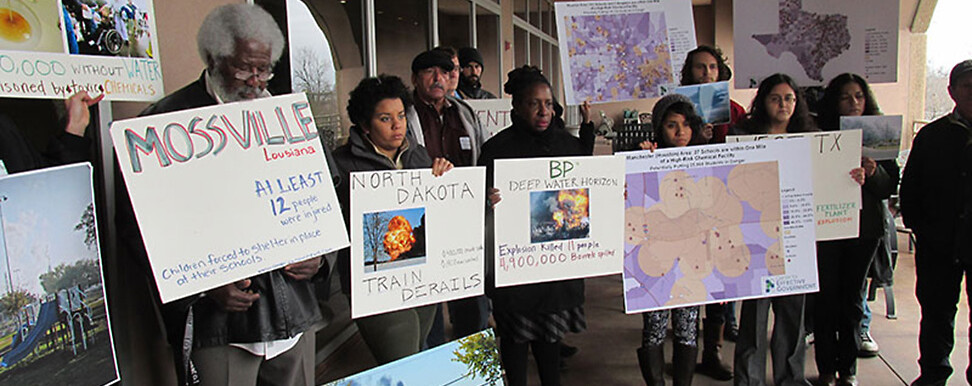
“We’ve fought for decades to close loopholes and get real checks on chemical leaks. These standards target the dangerous chemicals that create a huge cancer risk in communities like Mossville, Louisiana, and others throughout the country,” said Michele Roberts, national coordinator of Environmental Justice Health Alliance for Chemical Policy Reform (EJHA). “Delaying them is a policy choice with a human cost, measured in diagnoses, not dollars.”

Community Impact
“As a mother, grandmother, and lifelong resident of St. James Parish, I’ve seen too many of my relatives and neighbors fall sick from the air we breathe. These exemptions would only make our burden heavier,” said Sharon Lavigne, founder and director of RISE St. James, a leading community advocacy group based out of St. James Parish, Louisiana. St. James Parish is located in the Southeastern Gulf Coast Region of Louisiana. The area is also an epicenter of the Petrochemical Industry, often referred to as ‘Cancer Alley’ due to elevated levels of carcinogenic industrial air pollutants in the region.
Response from the Petrochemical Industry
Some industry groups argue that the Trump administration’s exemptions do not go far enough to deregulate the chemical industry. An article by the industry law firm Beveridge & Diamond noted that the “EPA does not seem inclined to give the petroleum refining and petrochemical sectors a ‘free pass’ on enforcement.” In September, the Trump administration issued its first Enforcement Alert identifying compliance concerns under the Clean Air Act’s benzene fenceline monitoring regulations at petroleum refineries. Beveridge & Diamond argue that the EPA will use this enforcement to “leverage benzene data to achieve more far-reaching monitoring and technology controls, well beyond existing requirements and completely absent from the fenceline monitoring rules themselves.” The firm warned industry professionals that the new regulations will require costly equipment upgrades and increased short-term air monitoring.
Toxic air pollution has a direct impact on public health, particularly for communities located near industrial sites. Regulatory shifts, such as exemptions or delays, can result in delayed protections, increased exposure risk, and an unequl burden for the 39% of U.S. residents living within a fenceline radius of the chemical industry and potential chemical disaster risk. As weather patterns evolve and climate stressors intensify, understanding how air-quality risks compound becomes increasingly critical.
What We’re Watching
We’ll continue to track:
- How this lawsuit moves through the courts
- Whether compliance deadlines are reinstated or further delayed
- Real-time air-quality data and community monitoring near chemical facilities
- Impacts on climate resilience, health equity, and environmental justice
Take Action, Stay Informed
Visit Ejforall.org and other community partners for updates, tips, and resources to advance protections against pollution and public health violations from the chemical manufacturing industry.
Stay tuned to Check The Weather for updates as this story unfolds.