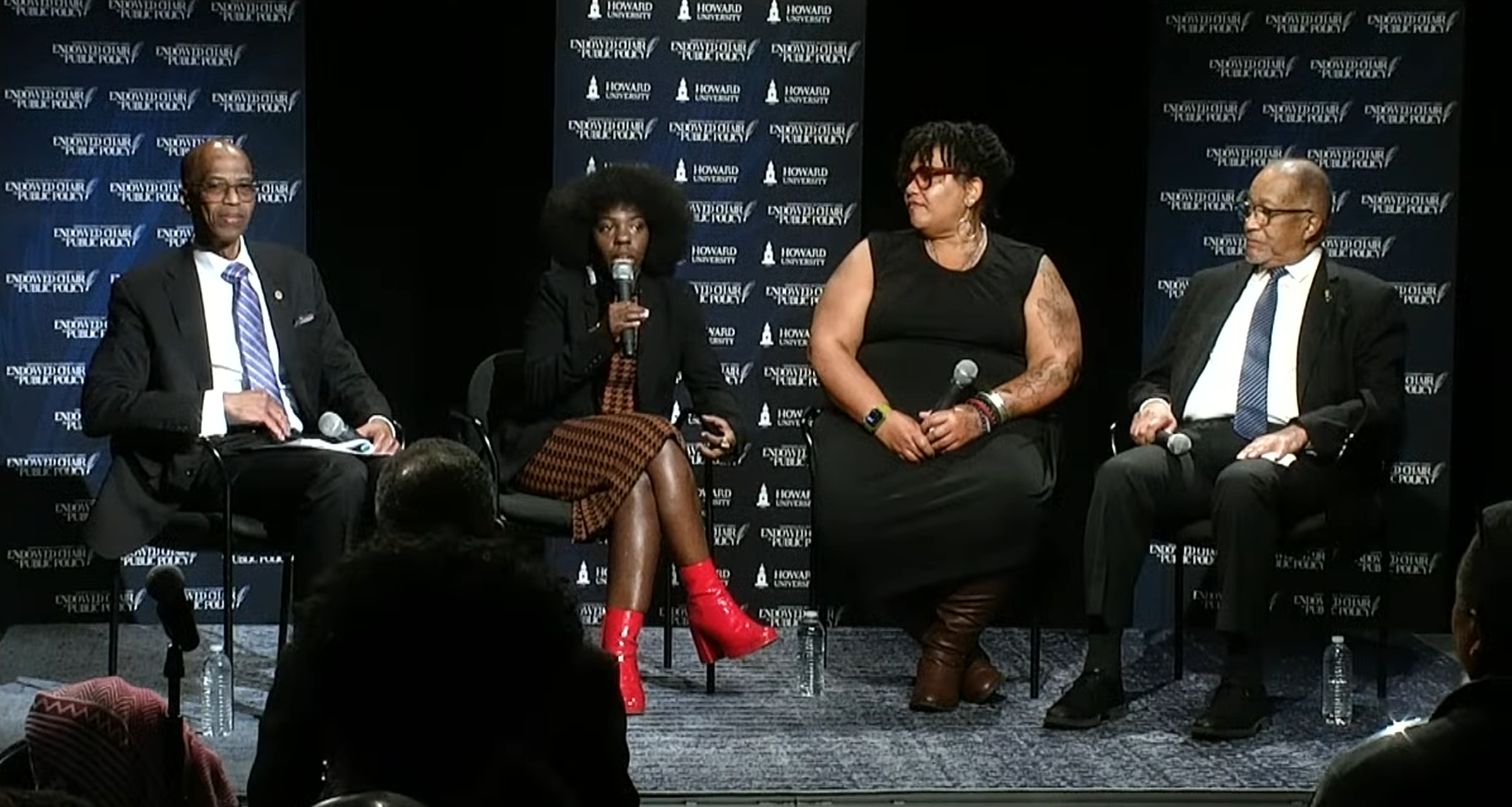
On Wednesday, November 12, 2025, the Gwendolyn S. & Colbert I. King Endowed Chair in Public Policy hosted a live-taped presentation titled “From Awareness to Action: Building Resilient Communities Through Environmental Justice.” The event brought together Howard University students, faculty, and members of the broader D.C. community for an in-depth conversation on the history, present, and future of Environmental Justice. Panelists also explored the growing role of environmental education and advocacy at Howard University and beyond.
The program opened with remarks from Marie C. Johns, Trustee Emerita and Chair of The Gwendolyn S. & Colbert I. King Endowed Chair in Public Policy. The panel was moderated by Rubin Patterson, Ph.D., Dean of the Howard University College of Arts and Sciences, a long-time champion of sociology, international collaboration, and environmental education.

Dr. Patterson introduced Rev. Ben Chavis, Ph.D., civil rights advocate, scholar, and President & CEO of the National Newspaper Publishers Association. Dr. Chavis is widely recognized as a pioneering voice for Environmental Justice. In 1987, he coined the term environmental racism in the landmark report Toxic Waste and Race, the first national study to link race and socioeconomic factors to the siting of hazardous waste facilities. The report sparked national and international attention to disparities in environmental protection across the United States.
Watch Earthkeeping Toxic Racism via PBS here: American Experience | Earthkeeping: Toxic Racism | PBS
Howard University Adjunct Lecturer and CheckTheWeather.net Founder & Editor-in-Chief, Kari Fulton, spoke about the importance of connecting Environmental Justice history, policy, and community advocacy to academic spaces and media—especially for students attending HBCUs and other minority-serving institutions.

Fulton shared that she includes Toxic Waste and Race as required reading in the syllabus for the Introduction to Environmental Studies course she co-teaches with Janelle Burke, Ph.D., Associate Professor of Biology and Chair of Howard’s Department of Earth, Environment and Equity (E3). The course is offered virtually to Title I high schools nationwide through the National Education Opportunity Network (formerly the National Education Equity Lab). Howard University President Wayne A.I. Frederick highlighted the course in his 2025 State of the University Address.
The course also uplifts the work of community environmental stewards, such as Akiima Price, Environmental Educator and Founder of Friends of Anacostia Park, a local advocacy group that champions public engagement and the preservation of the National Park in Southeast Washington, D.C.
Watch Akiima Price’s work in action: https://youtu.be/nz-FGM_TjBQ
Price is also the Founder and Practice Lead of Parkslove.us an initiative bringing trauma-informed, nature-based social work to parks and public places around the country.
The panel was followed by reflections from Charles Lee, Environmental Justice pioneer and visiting scholar at Howard University School of Law, and Hailey Morris, a graduating senior and campus leader with the Howard University Water Environment Association (HUWEA).
Lee discussed the continued legacy of Environmental Justice and reflected on his collaboration with Dr. Chavis in producing Toxic Waste and Race. He noted that a small advocacy group created the groundbreaking report without the backing of major universities or institutions. Lee previously served as Senior Policy Advisor in the EPA Office of Environmental Justice but retired earlier this year, following the Trump Administration’s rollback of historic environmental justice grants and reversal of Federal environmental and climate regulations.

Lee now serves as a visiting scholar with the Howard University School of Law and encouraged the audience, stating, “Now is the time to Reimagine the Future”. He noted that the growth of environmental education, and state and local policy can lead to collective advancements. He offered hope that one day these efforts could lead to improved environmental policies, such as strengthening the Clean Air Act.
Hailey Morris discussed how students on Howard University’s campus are increasing awareness and advocacy. Morris spoke about some of the student-led initiatives of HUWEA, including clothing swaps on the Yard and community service.
Audience members contributed a series of thoughtful and timely questions. Michele Roberts, Environmental Scientist and National Co-Coordinator of the Environmental Justice Health Alliance for Chemical Policy Reform (EJHA), emphasized the need to center chemical impacts in climate and energy conversations. She also discussed the ongoing cleanup and community impacts following the UPS flight explosion in Louisville, Kentucky.
Ra-Jah Kelly, Chief Technology Officer at The Washington Informer, asked about media tools and partnerships that could amplify these critical issues. Dr. Chavis underscored the vital role of the Black press and asserted that every Black newspaper should feature a regular column on environmental and green issues. The Washington Informer, the oldest African American–owned and operated newspaper in Washington, D.C., has long covered environmental issues and was the first outlet to publish a story on the launch of Howard University’s E3 Department.
Additional questions addressed data center expansion, career pathways in Environmental Justice, and international partnerships—particularly between Howard University and South Africa. Dr. Patterson championed Howard’s continued global collaborations, including a growing relationship with the University of Johannesburg.
Watch the full presentation “From Awareness to Action: Building Resilient Communities Through Environmental Justice” on Howard University’s YouTube page. The program is also scheduled for broadcast on the DC-based PBS affiliate, WHUT-TV, at a later date.